Skip to content

Short-term rental

Management software for short-term rental operators

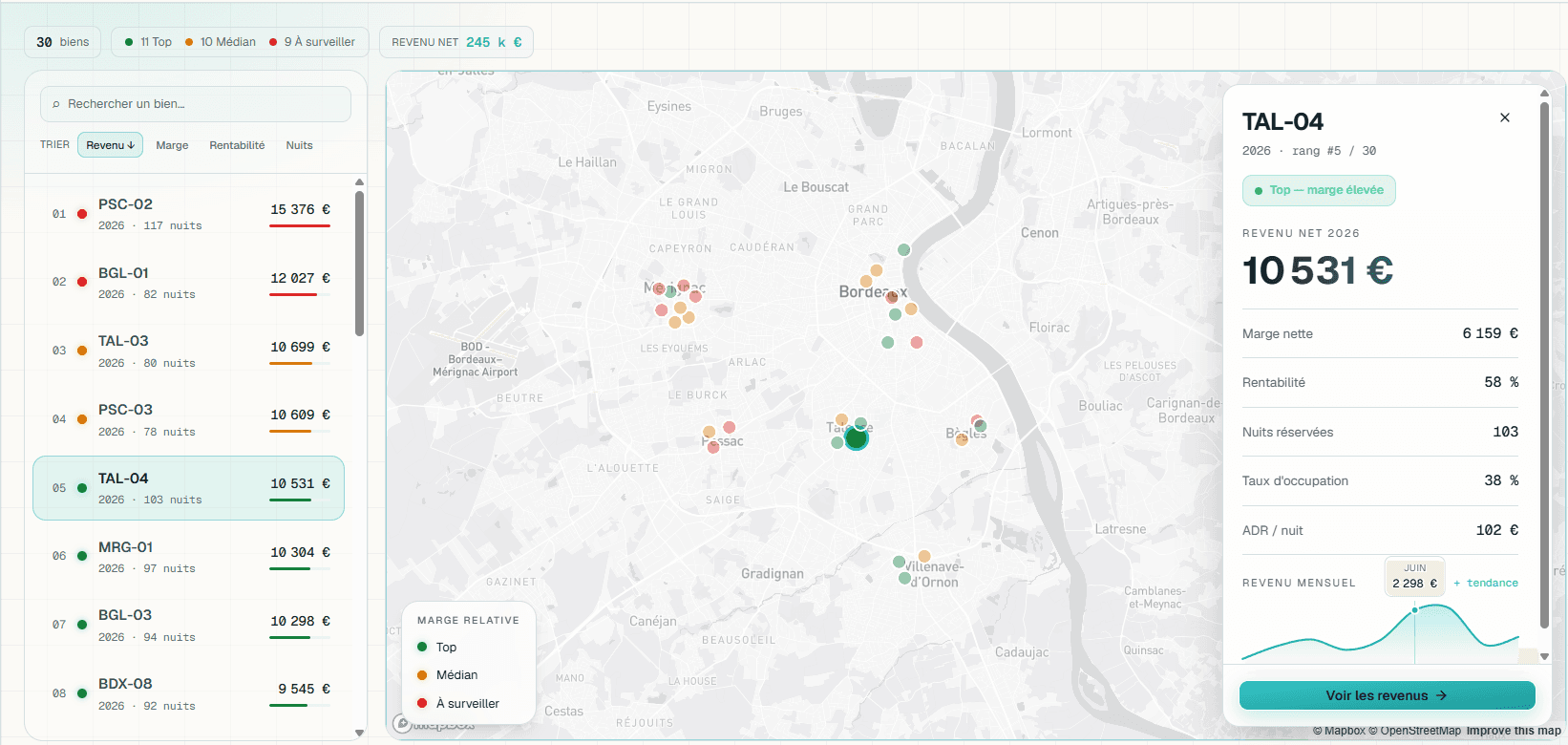
A furnished-rental operator knows what each property takes in. Almost none know what each property earns, because the number is scattered across four platforms, a cleaning contractor and a bank statement.

What your trade computes that others do not

The unit of management is the property, and the property is a profit centre in its own right. Its revenue arrives through several channels that do not bill the same way: commission withheld at source here, net payout there, tourist tax collected by the platform in one case and by you in the other. Adding up amounts that do not cover the same thing is the most common error in the trade, and it distorts every decision that follows.

Costs, meanwhile, are real and recurring: cleaning between stays, laundry, consumables, energy, internet, service charges, insurance, and the maintenance that arrives unannounced. Set against nights sold, they decide whether a studio with good occupancy really earns more than a flat let less often at a higher rate. Without that allocation, the trade-off is made on instinct.

On top sits an operational constraint a spreadsheet cannot carry: every departure triggers work that must happen before the next arrival. The cleaning schedule is not a task list, it is a time constraint between two bookings — and the day two departures and two arrivals collide in the same slot, the tool should flag it, not the guest.

What most operators work around by hand

The trade is simple to describe and hard to measure: that is where the time goes.

  • Revenue from each platform is copied into a spreadsheet every month.
  • A property's costs meet its revenue at year-end, if at all.
  • The cleaning schedule is sent by message, and corrected by message.
  • A maintenance job is not attached to any particular property.
  • A property's profitability is a conviction, not a number.
  • Nobody can say which property should be dropped.

Frequently asked questions

Does the tool connect to booking platforms?
Where a platform exposes a usable interface, yes, and that is what removes the monthly copying. Where it does not, importing the payout statement achieves the same result. The important part is not how the data arrives: it is bringing every channel to one definition of revenue, with commissions and taxes handled the same way, or comparing properties means nothing.
Can cleaning and maintenance live in the same tool?
Yes, and it is what gives the profitability calculation its last piece. Cleaning is scheduled from departures and arrivals, a job attaches to the property, and its cost joins that property's line automatically instead of ending up in a general overhead.
Does this work for coworking or longer leases?
Yes, provided it is planned for up front, because the revenue has a different shape: a night, a monthly membership and a rent do not count the same way. An operator mixing both models needs one place to compare them more than anyone.
From how many properties is this justified?
The threshold sits around ten, or lower if you operate across several channels and cities. Below it, a well-kept spreadsheet does the job. Above it, the cost is no longer data entry — it is not knowing which property to act on.

Let’s talk about your project

Describe what you are trying to build. We answer with an honest first read on feasibility and scope — even when the answer is that you do not need us.

Tell us about your trade