Why an off-the-shelf suite ends up costing more
A market ERP is built on an assumption: that the way you work is close enough to the way everyone else works. That holds for the basic mechanics: a quote becomes an order, an order becomes an invoice. It stops holding at the first place your trade has a rule of its own.
From there, two outcomes. Either you pay an integrator to bend the suite until it accepts the rule, and you inherit a layer of custom code that every version upgrade calls into question. Or your teams work around it: a spreadsheet on the side, a repurposed column, a “comments” field that actually carries a piece of management data. The second is the more common, and the more expensive, because it never shows up in a budget.
The symptom is always the same: the number that matters is no longer in the system. It is in a file, or in someone’s head. It cannot be recomputed, it cannot be audited, and the day someone disputes it, nobody can reproduce it exactly.
What the work covers
The full commercial cycle
Quotes, orders, delivery notes, invoicing, credit notes, with your states, your permitted transitions and your numbering. What already exists in your current setup is carried over, not reinvented.
Your calculation rules, coded once
Cost price, margins, tiered discounts, splits across entities, pro rata: the rule is written into the system, applied the same way everywhere, and traces back to the fact that produced it.
Stock and replenishment
Movements, reservations, thresholds, valuation by the method you actually apply, not the one the suite imposes because it is its own.
Field work and interventions
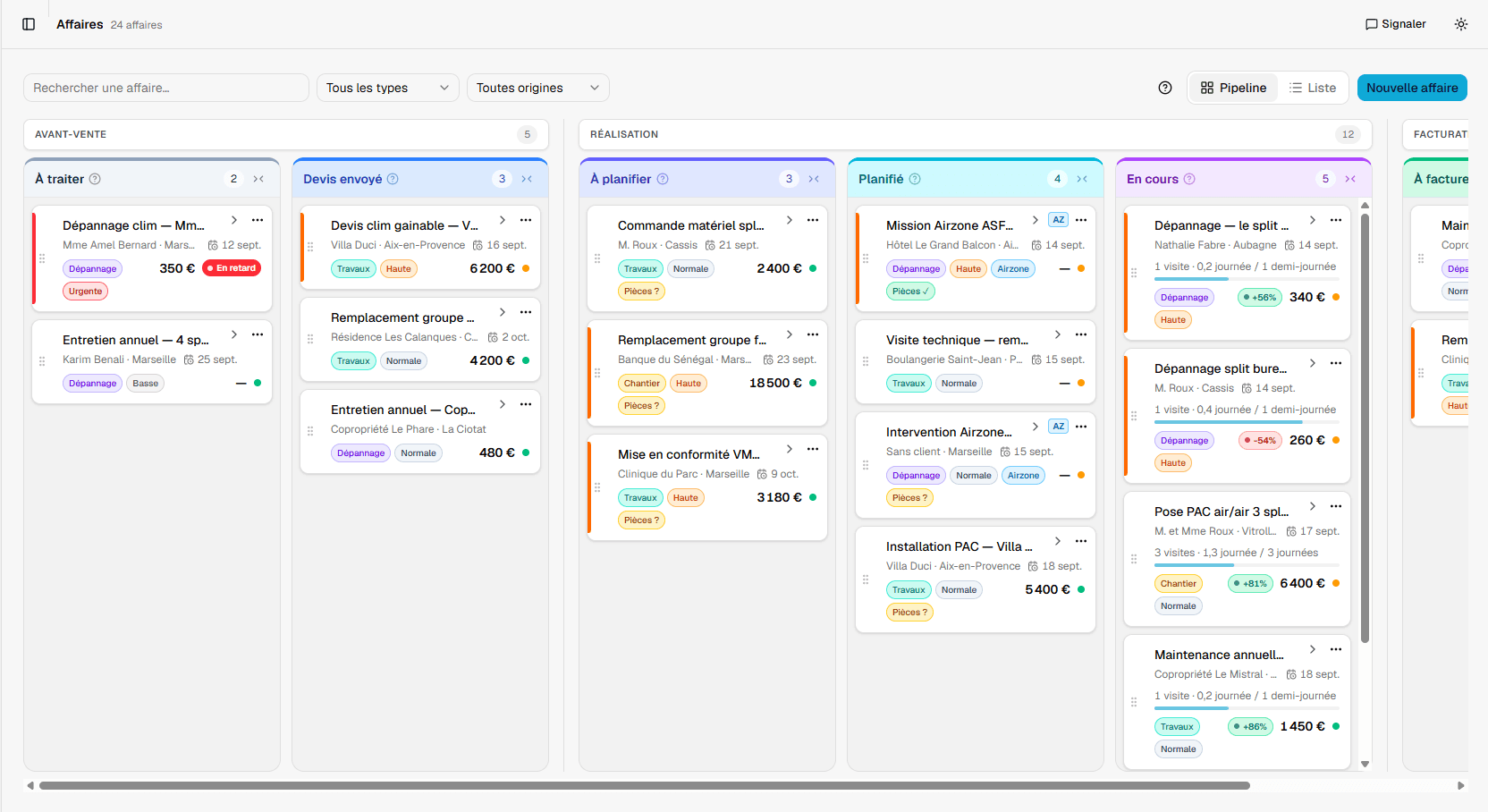
Scheduling, assignment, reports captured on mobile, offline included. What comes back from the field enters the job directly, with no re-keying at the office.
Roles, permissions and audit trail
Who sees what, who can approve what, and the history of what changed. An ERP that carries amounts must be able to say who altered them and when.
Migration of what you already have
Spreadsheets, no-code base, legacy software: the history is carried over rule by rule. A tool that starts empty forces you to keep the old one open alongside, and the two diverge within weeks.
The signs an off-the-shelf suite will not do
None of these is a failure of organisation. They are the places where your trade is more precise than the software claiming to manage it.
- A spreadsheet is the source of truth for a calculation the ERP cannot perform.
- A free-text field carries management data, because no field exists for it.
- Two people get two different numbers for the same question.
- A pricing or compensation rule is replayed from memory every time.
- Month-end close takes several days of manual rework.
- An integrator has quoted customisation costing more than the tool itself.
Does your system live in a spreadsheet? Take the ten-sign test