What your trade computes that others do not
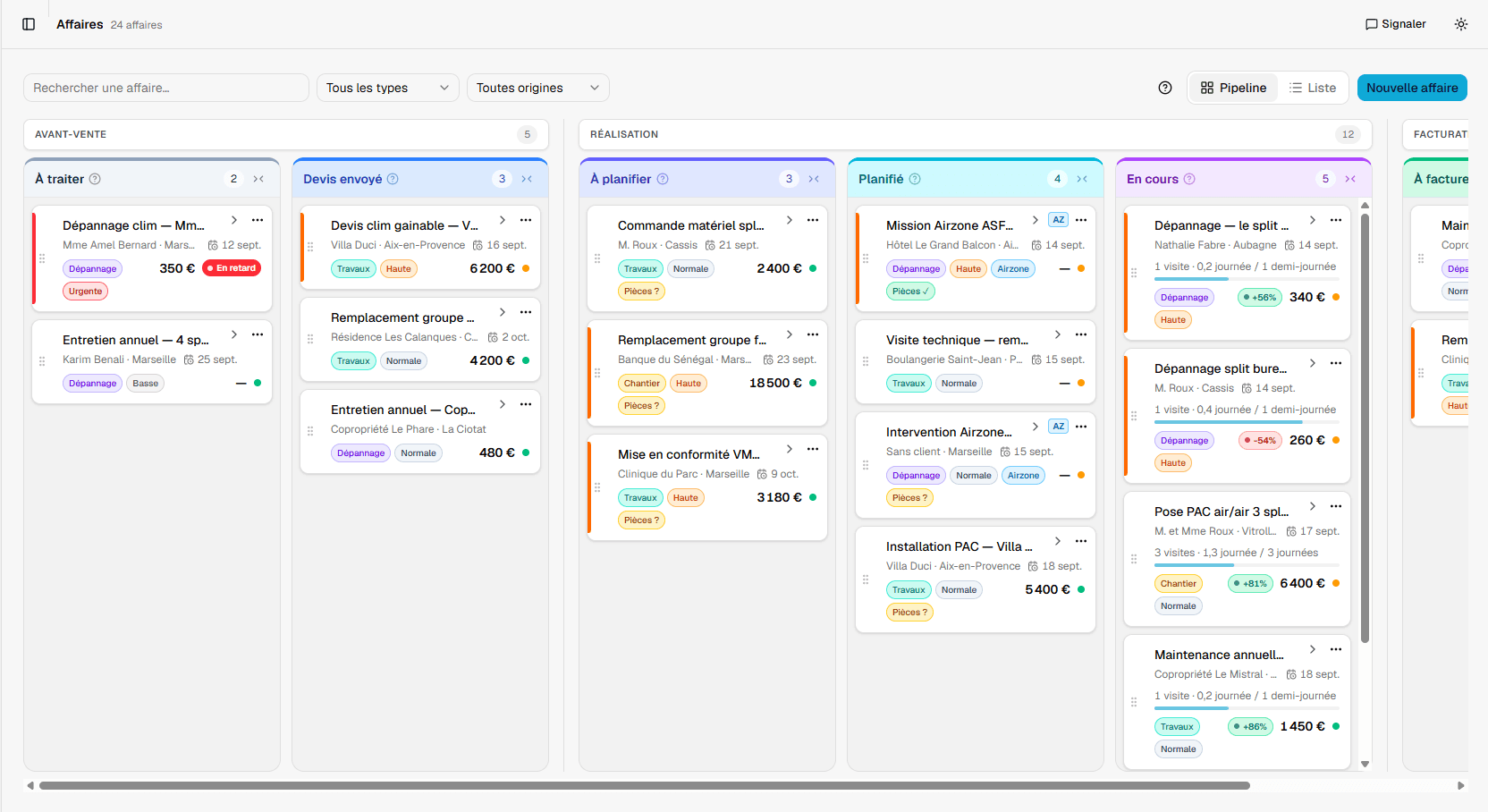
The contract carries response times, and response times carry consequences. An incoming request starts a clock that depends on the client, the criticality and sometimes the hour it arrives. Learning at month end how many jobs ran over is useless: it has to be visible while they are open, or the commitment is observed rather than met. That is the difference in kind between a tracking tool and an operations tool.
The scope is then twofold: a portfolio of assets and a portfolio of sites, which do not change at the same pace. A site enters or leaves the contract, a unit is replaced, a package moves from planned to reactive. Without an accurate description of that portfolio, planned maintenance is scheduled against the wrong scope, and visits land on equipment removed six months ago.
Finally, part of the work is done by others. The specialist called in on a package you do not cover remains your contractual responsibility: you answer for the time and the quality, and your margin absorbs the gap between what is invoiced to the client and what is paid to the subcontractor. Few tools bring those two amounts together job by job. That is exactly where a contract's profitability is decided.
What most providers work around by hand
These are the points where the contractual commitment outruns what the tool can follow.
- Response times are watched in the operations manager's head.
- The asset base lives in a spreadsheet updated when someone remembers.
- On-call jobs are recorded the next day, sometimes on Monday.
- What is invoiced to the client and what is paid to the subcontractor never meet.
- The job report is an email with photos attached.
- A multi-site contract's profitability is known at renewal.
Does your system live in a spreadsheet? Take the ten-sign test
What we have not done here yet
No engagement in the portfolio covers this sector. We would rather write that than let it be assumed. Here is the closest one by its management rules:
HVACJobs and field reports for an HVAC installerA single tool to track jobs, schedule interventions and produce field reports, replacing a general-purpose task manager pushed well past its purpose.Read the full case study